Football (also called soccer in some countries) is the most popular sport globally, with an estimated 4 billion fans. It’s not hard to see why, with its fast-paced action, skillful displays of athleticism, and intense competition. Football’s popularity is particularly evident in Brazil, where it’s considered the national sport and has an almost religious following.
Whether you are a seasoned football player or just starting out, understanding the laws of the game is crucial. With 17 football rules to keep in mind, it can be a challenge to keep track of everything. That’s why we’ve created this comprehensive guide to help you master the game.
From the equipment players need to wear to the different types of fouls and misconduct, we cover everything you need to know about football rules. Whether you’re a player, coach, or simply a fan of the game, this guide will help you gain a deeper understanding of how football works.
By familiarizing yourself with the rules of football, you’ll be better equipped to make strategic plays, avoid penalties, and enjoy the game to its fullest. So, let’s dive into the world of football rules and unravel the mystery together. Whether you’re looking to improve your skills on the field or simply want to impress your friends with your knowledge of the game, this guide is the perfect place to start.
Main Rules of Football
There are currently 17 laws governing football, which have seen some changes over the years. These soccer kickoff rules include everything, including the playing surface, fouls, and misconduct. It’s essential to comprehend these football laws in order to develop as a skilled player or knowledgeable fan. We also include the ultimate betting site for football in accordance with the laws.
Rule 1. The Field of Play
The football pitch is rectangular in design, measuring between 90 and 120 meters in length and 45 and 90 meters in width, with goalposts placed in the middle of each goal line. The length and width of the pitch are not fixed by basic football rules, but there’s a set minimum and maximum for the same.

The surface could be grass or an artificial surface like Astroturf in line with the FIFA Quality Programme for Football Turf.
The goal is made if two vertical metal posts are spaced 7.32 meters between and a crossbar 2.44 meters high. The penalty spot is at 11 meters perpendicular to the center of the goal.
Rule 2. The Ball
The soccer ball must be round, constructed of appropriate materials, have a circumference of 68-70 cm, weight of 400-450 g, and be spherical. At sea level, the ball pressure should be 0.6-1.1 kg/cm².
According to the football rules, in the case of a defective ball, it can be changed with the referee’s permission.
Rule 3. The Number of Players
Each team can have 11 players on the field, including the goalkeeper. Currently, the rules of football allow teams a maximum of five substitutions during a match, but it can vary according to the competition being played. Often, teams get an extra substitution if the game makes it to extra time.
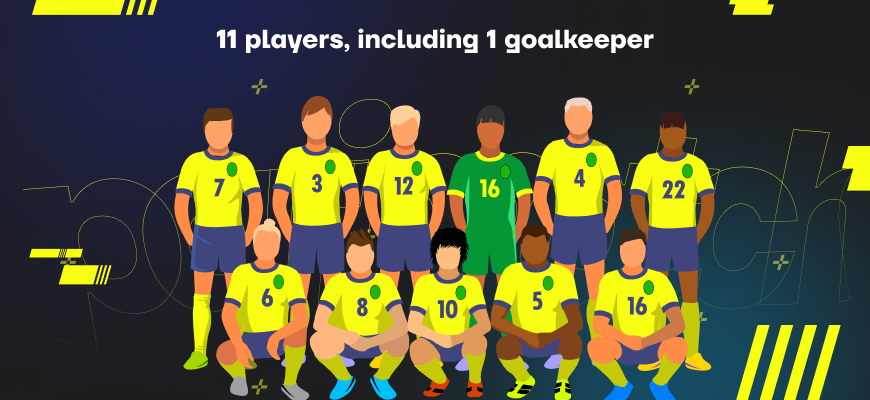
Before a substitute makes their way into the game, the fourth official checks their equipment. Subs have to wait for the referee’s approval to enter the pitch. Moreover, teams can only make substitutions when the ball is out of play.
Rule 4. The Player’s Equipment
Players must wear appropriate equipment, including shirts, shorts, socks, shin guards, and footwear. Goalkeepers must wear gloves and are permitted to wear track bottoms instead of shorts if they wish to.
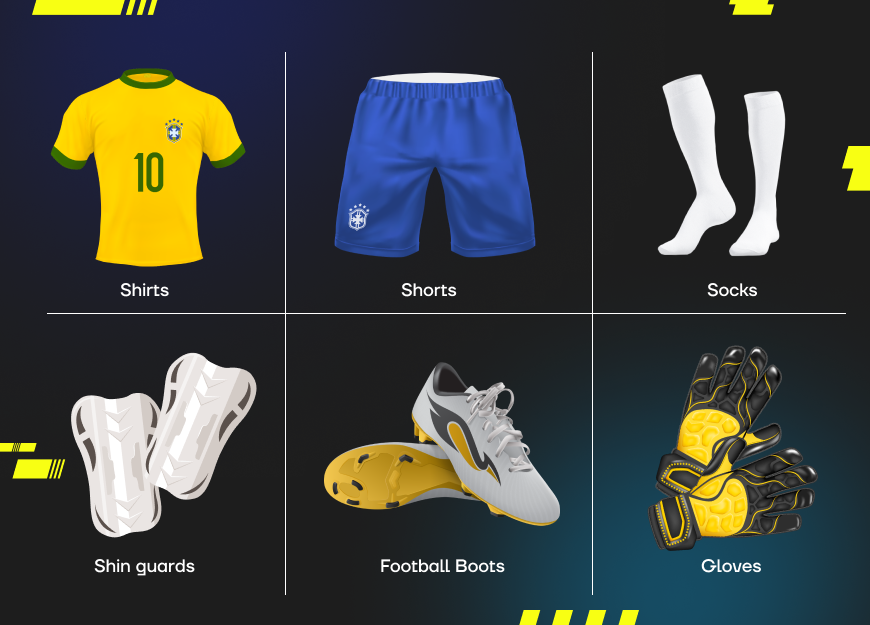
Players are allowed to wear protective gear such as face masks and headgear, stretchers, and facemasks as long as they are non-dangerous to themselves, their teammates, and opponents.
If any of a player’s equipment is stained with blood, they must change or rectify the gear before proceeding with the match.
Rule 5. The Referee
The referee is responsible for enforcing the laws of the game and ensuring that the match is played fairly. On the field, the referee has the last say on all decisions.
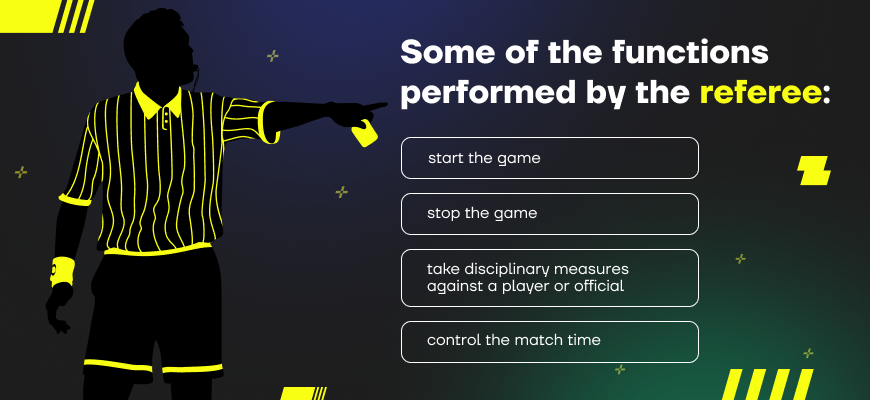
Some of the functions carried out by the referee include starting and stopping play, taking disciplinary action against a player or official, and timekeeping.
The referee makes calls on the pitch using a whistle to stop or start play.
Here are some of the referee’s responsibilities:
Rule 6. The Assistant Referees and Other Match Officials
Assistant referees help the referee in making decisions by positioning themselves on each touchline. Primarily, they determine which team has won a throw-in, corner kick, and goal kick or when and whether the ball has gone out of play. They are also responsible for offside calls and notifying the referee in case of serious infringements in their field of view in accordance with the football offside rules.
Serious football matches and tournaments include a fourth official overseeing the substitution process and showing additional time to the crowd.
Video Assistant Referees, commonly referred to as VAR, remotely monitor the games and make judgments on serious violations, serious foul play, challenges worthy of red cards, and penal claims.
Rule 7. The Duration of the Match
A football match has two halves of 45 minutes each, with a 15-minute break in between. Referees are free to add extra time to each half to make up for injuries, substitutions, and infringements in the game, such as time wasting.
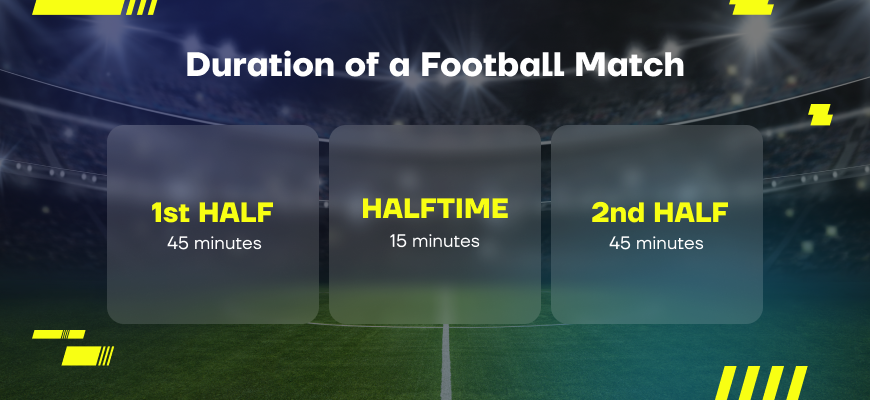
The fourth official displays the minimum added time to the crowd. However, the time added is only indicative. It is up to the referee to decide how long the half will be played.
Rule 8. The Start and Restart of Play
The match starts with a kickoff that is determined by a coin toss. The winning captain chooses the ball or which half they wish to attack in the first half. The sides and team kicking off are changed in the second half.
If a team scores a goal, the opponents restart play with a kick-off at the center.
Drop balls can also be used to restart the game where neither of the opposing teams is at fault. This may happen when there is a serious injury to a player, or a pitch invader makes their way to the field.
Rule 9. The Ball In and Out of Play
The ball is considered in play when it’s on the field of play and out of play when it has crossed the goal line or touchline.
All of the balls must be over the 12 cm line for the ball to be counted as out of play. The ball remains in play if it touches a match official or it bounces off the corner flag as per the football basic rules.
After the ball is out of play, it can be restarted in eight ways depending on how it went out of play: kick-offs for goals or starting the game, throw-in if it went across the sidelines, corner kick for corners, direct and indirect free kicks for fouls, the penalty for fouls inside the box and drop balls.
Rule 10. How the Outcome of a Match Is Decided
Ordinarily, the team that scores the most goals in a match is considered the winner. A goal is scored when the whole of the ball crosses the goal line between the goalposts and under the crossbar.
However, there are some circumstances allowed by football game rules when the ball crossing the goal line isn’t considered a goal. For example, if a goalkeeper kicks the ball from a goal kick straight into the opponent’s goal, a goal kick is awarded to the opponent. Brazilians refer to this as post-to-post.
Rule 11. Offside
Probably the most controversial issue as of now, the football offside rules, have two criteria to be decided:
- A player is in an offside position if they are closer to the opponent’s goal than both the ball and the second-to-last defender.
- A player is also deemed to be offside if any part of their body, head, or feet is in the opponent’s half after the last defender in the opponent’s half when the ball is played.
- If an attacking player willfully and knowingly obstructs the goalkeeper of the defending team even if the player is not involved in play leading to the goal.
Some of the most overlooked yet crucial parts of the offside rule include the following:
- The body referred to in this case refers to any part of the body that can score a goal, excluding the arms and hands of an attacker.
- If the keeper is out of their line, they count as a defender, and the defender closest to the goal will be termed as the keeper.
The referee awards an indirect free kick to the defending team in the case of an offside offense.
Recently, the officials are encouraged to hold before calling close offside calls and let play continue to deny the attackers a goal-scoring chance, and the replay is reviewed to determine whether offside is the right call.
Rule 12. Fouls and Misconduct
Fouls and misconduct include tripping, pushing, holding, and using excessive force. Yellow and red cards may be shown to players who commit serious offenses. Two yellow cards to a player add up to a red card, and the infringing player is sent off without replacement.
Five yellow cards will warrant a player missing the next game, and 10 yellow cards will earn them a suspension for the next two games, after which the tally starts from 0 again. A straight red card, either from obstructing a clear goal-scoring opportunity or foul play, will suspend a player for the next two games. Red cards cover all competitions, while yellow cards only account for the competition in which the player has been booked.
Rule 13. Free Kicks
A free kick is awarded to a team when an opponent commits a foul or misconduct. In football game rules, there are two types of free kicks, either a direct or an indirect free kick. In a direct free kick, the ball is kicked toward a goal without touching another player, while an indirect free kick involves the ball coming off another player before a goal is scored.
The defending players in a free kick must retreat at least 9.15 meters from the site of the free kick. The referee usually estimates the distance using steps. Recently, we’ve seen attacking players in a free kick create a fake wall to obstruct the defending keeper. The rule is that the wall of attacking players be at least two feet in front of the defending players’ wall so as not to disturb it.
Rule 14. Penalty Kicks
A penalty kick is awarded to a team when a foul is committed by an opponent inside their own penalty area.
The attacking player takes the spot kick from the designated area in a single shot. As the ball is kicked, the goalkeeper must have at least one foot on the line or behind it.
All other players, excluding the keeper and penalty taker, must be at least 9.15 meters away from the ball. If the referee spots infringement by either the keeper or defending players before the ball is kicked, then he/she may call for the spot kick to be retaken.
Rule 15. The Throw-In
A throw-in is awarded to a team when the ball goes out of bounds over the touchline. When taking a throw-in, a player must have both feet placed on the ground, and the ball is thrown overheads from behind. Opponents must stand at least 2 meters from where the throw-in takes place. Goals cannot be scored directly from a throw-in.
If a throw-in goes straight into an opponent’s net, a goal kick is awarded. If a player throws the ball from a throw-in straight into their own net, a corner kick is awarded to the opponents.
The offside rule, however, does not apply to throw-ins. The receiving player can be behind the last defender, and the goal will still count.
Rule 16. The Goal Kick
A goal kick is awarded to the defending team when the attacking team kicks the ball out of bounds over the goal line.
For the play to restart, any player from the defending team can kick the ball from the six-meter goal line. The outfield players can stay as close as outside the six-meter line, but the offensive players must be outside the penalty area for a goal kick.
Rule 17. The Corner Kick
A corner kick is awarded to the attacking team when the defending team kicks the ball out of bounds over their goal line.

The ball should be placed within the quadrant marked by the flag when kicked into the field by an attacker. The defending team is not allowed by soccer rules and positions to be closer than 9.15 meters from the ball when a corner is taken. A goal is counted if the ball goes straight in from a corner. If the ball from a corner is kicked and curls out of play and curls back in from the corner, it counts as a goal kick.
The corner flag is used to differentiate if the ball goes out for a corner or a throw-in around the corner of the pitch.
***
Players, coaches, and spectators must all be familiar with the football rules. Understanding these regulations can help you enjoy the game and appreciate the abilities of the players, from the field of play through fouls and misbehavior. Understanding football rules is a crucial first step to taking part in the game and enjoying it. For spectators, it is even better as it boosts your chances of winning when placing bets at Parimatch.
Final Thoughts
In conclusion, football’s regulations form the basis for the most well-known sport in the world. They guarantee consistency, safety, and fair play at all levels of competition. The fundamental principles do not change, even though exact restrictions may vary based on the organization or nation.
The regulations include a wide range of game-related topics, including the field’s dimensions and configuration, as well as ball handling, fouling, and the offside rule. For players, coaches, officials, and fans alike to fully appreciate and enjoy the game, it is imperative that everyone is aware of these regulations.
It’s essential to remember that football rules are always changing as new innovations and concepts are brought to the game. Soccer is a dynamic and thrilling game with countless opportunities for invention and growth because of its versatility. To properly appreciate the beauty and complexity of the game, it’s crucial to keep up with the most recent regulations and innovations as the sport develops and grows.
For punters, it is even better to grasp these football rules as it will keep you in the loop when placing bets. You stand a chance to win big with the knowledge you’ve now acquired. Take a chance, join Parimatch, and reap big from your football knowledge.
Some reasons why you should play at Parimatch are:
- Parimatch is an established brand with a global presence.
- We offer a wide range of casino games, giving players plenty of options to choose from.
- Parimatch has low minimum deposit requirements and ensures fast and secure payouts.
- Parimatch has a dedicated customer support team available 24/7 to assist you with any queries or concerns.
- We have a user-friendly mobile app that allows you to bet on the go, anytime and anywhere.
- Parimatch offers a variety of bonuses and promotions for new and regular users, giving you more chances to win big.
Don’t waste any more time. Sign up on Parimatch, put your soccer rules knowledge to the test, and make money.
FAQ
What are the football rules?
Football rules are a set of regulations that govern the conduct of the game. The rules define the size of the field, the number of players, the ball, and how the game is played. They also set out the criteria for scoring, fouls, and other aspects of the game.
What are the 7 rules of football?
There are no specific “7 rules” of football, as the rules of the game are extensive and cover various aspects such as the field, ball, players, fouls, and scoring. However, some of the essential rules include the offside rule, the handball rule, and the criteria for scoring a goal.
What are the top 10 rules of football?
The top 10 rules of football can vary depending on the perspective, but some commonly cited ones include the offside rule, handball, fouls, throw-ins, corners, penalties, substitutions, goal kicks, yellow and red cards, and the duration of the game.
How many and what are the rules of football?
There are 17 rules, also known as laws, that govern the sport of football. These laws cover various aspects of the game, including the field of play, the ball, player equipment, fouls and misconduct, the role of the officials, and the start and restart of play.